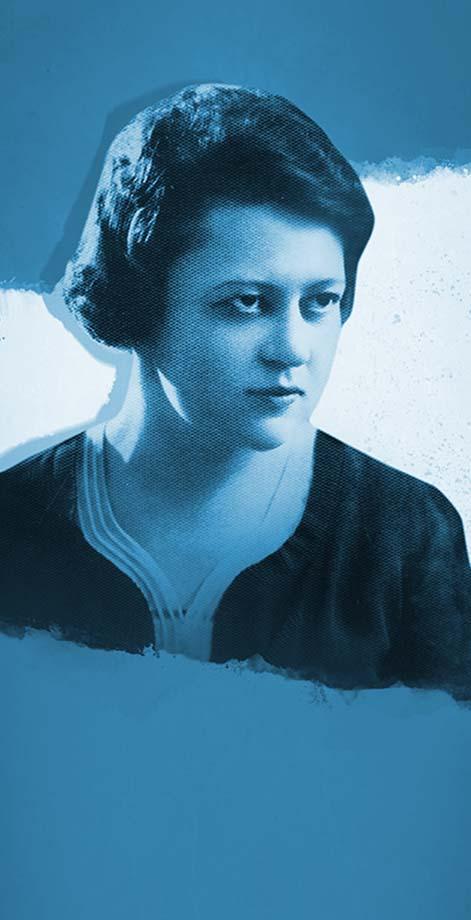
4 janvier 1900, Bourchtyn (aujourd'hui en Ukraine) – août 1942, ghetto de Lviv
Debora Vogel était une poétesse ainsi qu’une critique d’art et de littérature écrivant principalement en polonais et yiddish. Ses œuvres expérimentales combinaient poésie et art visuels.
Elle est née en 1900, dans la petite ville de Burshtyn en Galicie (aujourd’hui en Ukraine).
Pendant la Première Guerre Mondiale, sa famille fuit d’abord à Vienne puis à Lviv où Debora Vogel passa la majorité de sa vie. L’Allemand était sa langue de prédilection quand elle commença à écrire, mais sa première œuvre publiée était écrite en polonais. Rachel Auerbach, une écrivaine et défenseuse de la culture Yiddish moderne, l’encouragea à s’essayer à écrire en Yiddish, même si ce n’était pas parlé chez elle. Finalement, elle décida d’écrire en polonais, hébreu et yiddish. Elle était active dans les cercles littéraires yiddish et écrivait pour des journaux en polonais. Debora Vogel publia des essais sur la poésie, ainsi que des revues d’art et des poèmes. Elle était amie avec l’écrivain et artistet Bruno Schulz.
L’expérimentation motivait la poésie de Debora Vogel. Écrits principalement dans les années 1930, ses poèmes incorporaient à la fois le minimalisme et le radicalisme qui devinrent les traits caractéristiques de son œuvre.
Ses expérimentations poétiques combinaient poésie et arts visuels, utilisant une méthode qu’elle appelait la technique des « mots blancs ». Elle publia deux volumes de poèmes ‘Tog-figurn’ (« Figures du jour », 1930) et ‘Manekinen’ (‘Mannequins’, 1934), ainsi qu’une collection de montages intitulés « Fleurs d’Acacias » qui firent leur apparition dans deux versions linguistiques : en Yiddish en 1935, intitulé ‘Akacjes blien’, et en polonais en 1936, sous le nom de ‘Akacje kwitną’.
En 1932, Debora épousa Szulim Barenblüth, un architecte et ingénieur de Lviv. Leur fils unique, Anshel, naquit quatre ans plus tard. Quand la ville fut prise par les nazis, la famille se retrouva dans le ghetto de Lviv, et ils y furent finalement assassinés durant sa liquidation en 1942.
Poem on waiting (2)
translated into English by Anastasiya Lyubas
I have worn out
all my dresses
waiting for you.
I put them on the first time
took them off the last time
in a month of sticky sun, in a month of tired leaves
in the evening garden
a chestnut red dress,
ready to wrap me
soft as velvet.
The rust-gold dress
for the month of tired leaves
and bleak flowers’ second blossoms.
And a coral-colored dress,
in which I look like a cold coral
in the glass sea of afternoon streets
with a smell of the seaweed of bodies.
Never again
will I worry what dress to wear for you.
In: Blooming Spaces: The Collected Poetry, Prose, Critical Writing, and Letters of Debora Vogel,
translated, edited, and with an introduction by Anastasiya Lyubas, Boston 2020.
A poem of colors
translated into English by Anastasiya Lyubas
The white is flat:
a usual house seen from up front,
a boring house where nothing happens,
a flat paper rectangle, which wants nothing.
The gray is long and round.
You have nowhere to go, so similar are the houses.
And you go. Go impatiently along streets
until the street grayness gives out
and closes round the dwelling where you live.
The yellow elastic heat tin,
the tin yellow is deep.
Like the distance of things that do not return.
In: Blooming Spaces: The Collected Poetry, Prose, Critical Writing, and Letters of Debora Vogel,
translated, edited, and with an introduction by Anastasiya Lyubas, Boston 2020.
Dolls
translated into English by Anastasiya Lyubas
She stood for a long time
like a half act of porcelain
behind a milky windowpane
BARBER’S SHOP—BROAD STREET—15.
She was kneaded
from red porcelain dough
of women’s bodies by Rubens
and seduces with two pink breast-apples
as if with round shiny eyes.
With half-open eyes
the porcelain smiled
smooth and watery, as if enchanted
by everything which happens in the world
on the second, the other side of the window.
And on the other side of shop window
elastic dolls stroll
with sweet long almonds of eyes
and agile hands and feet.
Dolls with a movable heart
carry glassy pupils of eyes under eyelashes with mascara
and a carmine smile of Chameleon brand
and faces of smiling porcelain.
At the same time
pink dolls at fifteen Broad Street
show their lively breasts like round apples
and sadness like squandered happiness.
In: Blooming Spaces: The Collected Poetry, Prose, Critical Writing, and Letters of Debora Vogel,
translated, edited, and with an introduction by Anastasiya Lyubas, Boston 2020.