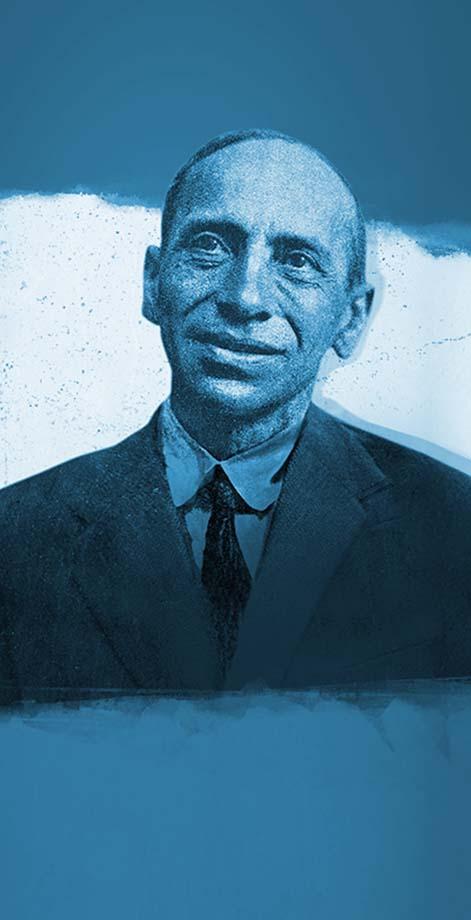
4 V 1877, Cracovie — 4 VI 1942, ghetto de Cracovie
Mordechaj Gebirtig, poète et auteur de chansons yiddish dans la Pologne d’avant et de pendant la guerre, est étroitement identifié avec Kazimierz, le quartier juif de Cracovie.
Il est né à Cracovie le 4 mai 1877 sous le nom de Markus Bertig. Son éducation consista à fréquenter le kheder, l’école religieuse juive de base, et une école publique. Par la suite, il devient apprenti chez un maître menuisier qui lui enseigne le métier. Il travailla activement à améliorer le niveau de vie des travailleurs par le socialisme, ce qui est évident dans ses œuvres littéraires. Pendant la Première Guerre mondiale, il servit comme ambulancier dans un hôpital militaire à Cracovie. Par la suite, il travailla dans l’atelier de menuiserie et de tapisserie appartenant à son frère Leon. Il s’essaya aussi au théâtre.
Au fil de sa carrière, il commença à s’appeler Mordechaj Gebirtig, un nom de famille qui indiquait qu’il était en train d’être « né de nouveau », tiré du nom allemand Geburt, ou « naissance » en anglais. Son premier poème, Der Generalshtrayk (« Grève générale »), est publié en 1905 dans un hebdomadaire, Sotsyaldemokrat (« Social-Démocrate »). Un recueil de ses poèmes Folkshtimlekh (« Mélodies Populaires ») fut publié en 1920, et un recueil de ses chansons, Mayne lider (« Mes chansons »), en 1936. Ses œuvres, écrites en yiddish, ont été chantées sur la scène de nombreux théâtres juifs dans de nombreuses parties du monde. Mordechaj Gebirtig a écrit la chanson emblématique de l’Holocauste, Unzer shtetl brent (« Notre Vile Brûle ») commémorant le pogrom de Przytyk le 9 mars 1936. Il est devenu l’hymne de l’Organisation Juive de Combat et a été chanté dans le ghetto de Cracovie et d’autres camps de concentration. Après la guerre, il est devenu un hymne symbolique pour les survivants de l’Holocauste.
Pendant l’occupation, il a d’abord été confiné à Łagiewniki près de Cracovie, puis transféré dans le ghetto de Cracovie. Il meurt le 4 juin 1942, abattu par un officier de la Gestapo sur le chemin du camp d’extermination. Les chansons de Mordechaj Gebirtig documentant la vie juive d’avant-guerre sont devenues des reliques inestimables d’un monde perdu.
Our Town Is Burning
Voice: Bente Kahan
Accordion: Dariusz Świnoga
Translated into English by Dahlia Pfeffer Luxemburg
Recording of a concert in Stockholm City Hall, 1995.
It’s burning brothers, it’s burning
Oh, our poor town is burning
Angry winds and loud noises
Are coming crushing and blowing away
The wild flames are growing
Everything around is burning!
And you are standing just like that and watching with folded arms
And you are standing just like that and watching
Our town is burning!
It’s burning, brothers, it’s burning
Oh, our poor town is burning
The fire tongues have already engulfed the whole town
And the evil winds are screaming
Our town is burning
And you’re standing just like that and watching with folded arms
And you’re standing just like that and watching
Our town is burning!
It’s burning, brothers, it’s burning
Oh, God forbid, the moment is coming
that our town together with us
will turn in flames into ashes
and, like after a battle, only empty, black walls will remain
And you’re standing just like that and watching with folded arms
And you’re standing just like that and watching
Our town is burning!
It’s burning brothers, it’s burning
And only you can help it
If the town is dear to you,
Take the buckets, put out the flames
Put them out with your own blood!
Show that you can do it!
Don’t stand, put out the fire
Our town is burning!
Farewell Cracow. Bente Kahan sings Mordechaj Gebirtig
Text und Musik: Mordechaj Gebirtig
Gesang: Bente Kahan
Akkoredon: Dariusz Świnoga
Geige: Mirosław Kuźniak
Aufnahme von TVP2, 1992.
Reyzale
Translated from Yiddish into English by Bente Kahan
I am standing in a street
carefully I take a peek
at that old and wooden home
where Reyzl lives, my dearest one
each night before her house her heyzl
I walk by and hum
whistle and then call out Reyzl,
Come, Come, Come
A window suddenly unlocks
the little house is waking up
A sweet voice sounding in the street
my Reyzale she starts to speak
“Wait a while, it’s mother’s order
soon I will be free
walk once more around the corner
One, Two, Three”
Happily I take a walk
cracking nuts, I sing. I talk
Then hear my sweet Reyzale
runs down a staircase-ale
lovingly, I look her way
embrace my only one
kiss her on her forehead and say:
Come, Come, Come
“Dovidl, I’m begging you,
whistle is not a thing to do
“I hear he’s whistling” says my Mum
she’s so upset and won’t be calm
“whistling, she says, is not Jewish
for them it may be
Just give a simple sign in Yiddish
One, Two, Three
“I will not whistle as you say
I promise you that from today
I will become a religious Jew
because I am in love with you
Every Shabes, my dear Reyzl
I will please your Mum
praying in that little kleyzl
Come, Come, Come”
“I believe you, oh my lad
and that’s why, dear Dovidl
I’m knitting a nice tfiln-bag
with a David star, mogin-Dovidl
If your classmates they will like it
say it is from me
that Reyzale my love she knits in
One, Two, Three”
“A present, thanks, that’s really sweet,
Oh, Reyzale, I love you so
I love your mother, I love your street,
I love your home, please do not go
I love your little house, your heyzl
that’s where you are from
But now your mother’s shouting “Reyzl:
Come, Come, Come”
Once again I start to walk
cracking nuts, I sing, I talk
Then I hear my dearest one
runs up the stairs, I’m left alone
The street is calm so it seems
my Reyzl is back home
Come to me in my dreams, Oh
Come, Come, Come